“It looked as though Armageddon had swept through”: The story of Natalia Dehtiarova from Mariupol has become part of the Museum of Civilian Voices founded by the Rinat Akhmetov Foundation
24.08.2026
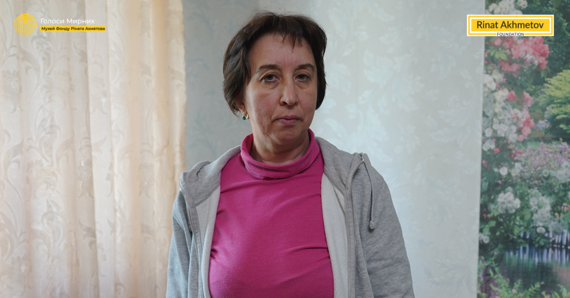
In 2022, Natalia Dehtiarova ran through shelling to the hospital where her severely wounded husband, Serhii, was being treated. In the overcrowded ward, he managed to say only two words: “I’m dying.” A few days later, the family also lost Natalia’s father-in-law in the besieged city of Mariupol. The woman shared her story with the Museum of Civilian Voices founded by the Rinat Akhmetov Foundation.
“I don’t know how I found him. I ran down the corridor, and then somehow turned back by instinct. I saw that someone dear to me was lying on the bed. When the doctors were operating on him, they were saying there was no chance,” Natalia recalls.
Serhii was killed while trying to find food for his family. At that moment, an explosion occurred: he suffered a severe abdominal injury. The city hospital was already overcrowded with wounded people, and there was a shortage of medicines, so Serhii could not be saved. To this day, Natalia does not know where he is buried.
Soon afterwards, the family suffered another loss: when the woman ran to her father-in-law, Volodymyr, to tell him about his son’s death, she discovered that he too had been killed by shrapnel wounds.
“We all cried. Grandad was buried in the vegetable garden – or rather, what was left of him,” says Natalia’s son, Andrii.
Before the full-scale invasion, the Dehtiarov family’s life was inseparably linked with Mariupol. Natalia, her husband, and several generations of their families worked at Azovstal, and this was where their children grew up. Today, only memories and pain remain of that life. Natalia still cannot recall those terrible days without tears.
“It was terrifying, with relentless shelling. It looked as though Armageddon had swept through: everything was black, the sky was black, and on the road I saw a dead person,” the woman remembers.
According to her son, these tragedies severely worsened his mother’s psychological condition. It later turned out that she had previously concealed a devastating diagnosis from her family – Parkinson’s disease. After losing her loved ones and enduring the horrors of war, Natalia’s condition began to deteriorate rapidly. At that time, Mariupol had been left without water, electricity, or heating. All responsibility for the family fell on the shoulders of Andrii’s elder sister, Oksana. She collected humanitarian aid, looked after her loved ones, and on one occasion even managed to obtain medicine for Natalia.
“A month later, my daughter managed to get the medicine. She kept going to the pharmacy. She stood in queues there all day long. Then a miracle happened – a woman brought the medicine after the pharmacy had closed. She said it had been left over from her relatives,” Natalia says.
Thanks to the medication, the woman’s condition improved, and she was able to walk again. In the summer of 2022, the family finally managed to leave the occupied city of Mariupol. Today, they live in Rivne, where they work, study, and are trying to rebuild their lives. But the pain of everything they endured and witnessed in Mariupol remains with them to this day.
Watch the story of Natalia Dehtiarova’s family: https://bit.ly/3Uw0AdL
The collection of the Museum of Civilian Voices founded by the Rinat Akhmetov Foundation now contains more than 145,000 stories about the war. It is the world’s largest collection of testimonies from civilians affected by russia’s war against Ukraine.