“It’s a Miracle That the House Collapsed Rather Than Burned Down, and Everyone Survived”: The Story of Veronika Baida and Her Children Becomes Part of the Museum of Civilian Voices Founded by the Rinat Akhmetov Foundation
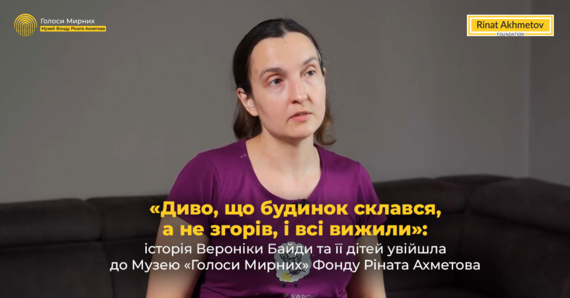
Veronika Baida woke up to the ceiling collapsing on top of her. In the very first second, she instinctively shielded her young son Orest with her body. Somewhere nearby, among the debris, were her three daughters — Eva, Zoriana, and Alisa. In April 2026, during a russian strike on Kyiv, the family’s home was completely destroyed. The woman shared her story with the Museum of Civilian Voices founded by the Rinat Akhmetov Foundation.
Veronika recalls that everything happened in an instant. The greatest horror was realizing that the girls were trapped under the rubble. They did not dare clear the debris by hand because of the deadly risk: there was a gas cylinder nearby that could detonate from any careless movement.
“It was a 50-liter cylinder. If it had exploded, everything would have collapsed and no one would have survived. When the neighbors came, they wanted to dig us out. I told them not to, because everything was still holding for the time being. We could breathe, our legs were not trapped, nothing was pressing down on us. We were simply waiting for the emergency services because they would remove it carefully. There was a risk that it could shift further. And that was frightening,” the woman says.
Yet even amid the chaos and danger, Veronika’s daughters showed incredible courage. The youngest, Alisa, was almost unharmed and managed to escape through a window. The eldest, Eva, despite her own injuries, pulled Zoriana out from under furniture that had trapped her, found warm clothes for everyone, and began organizing the evacuation.
“I checked whether everyone was alive. We kept calling out to each other the whole time. I had superficial wounds, bruises, and hematomas. At that moment, I saw that there was blood on my pajamas, but there wasn’t much. The adrenaline was still working. At that moment, I didn’t feel my injuries,” recalls Eva Batchenko.
When rescuers pulled everyone affected out from under the rubble, Veronika finally breathed a sigh of relief — all the children were alive, although they had suffered injuries. But the home the family had spent more than ten years making their own was completely destroyed by the russian army.
Just the day before the strike, the woman had painted the bathroom in the house, sent her husband, a serviceman, a photo of the renovated interior, and was delighted with the family’s cozy home. Now the house, all their belongings, and the memories associated with that place are lost forever.
As an experienced psychotherapist, Veronika Baida focused on the healing process for herself and her family after what they had been through. After the shelling, the family essentially has to start their lives from scratch.
“It’s a miracle that the house collapsed rather than burned down, and everyone survived. Our entire family has been traumatized — at the level of a minor car accident. It was difficult for me even to go to the store because there was so much going on around me: everything was noisy, everything was bright. It would simply overwhelm me, and I would start crying. My skills helped me stabilize myself. I cried, got up, went, and did what needed to be done. I hope we will rebuild quickly and return home. This is my land, it belongs to me,” she says.
Watch the story of Veronika Baida’s family here: https://bit.ly/4pQQZKo
The collection of the Museum of Civilian Voices founded by the Rinat Akhmetov Foundation already numbers more than 145,000 stories about the war. This is the largest collection in the world of testimonies from civilians affected by russia’s war against Ukraine.