“Tell the Whole World”: “Kateryna Savenko’s Diary” Presented in Kyiv
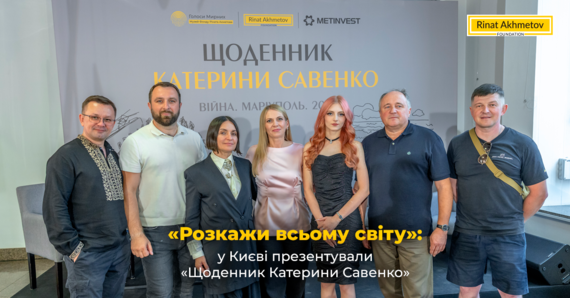
On July 21, the Museum of the History of Kyiv presented the book “Kateryna Savenko’s Diary” — a personal testimony of a Mariupol resident about the first weeks of the russian siege of the city. The publication was released with the support of the Rinat Akhmetov Foundation and Metinvest Group.
Forty-two-year-old Kateryna Savenko worked at the Ilyich Mariupol Metallurgical Plant. She made the first entry in her diary on February 24, 2022. Two notebooks contain 34 entries about the lives of her family and neighbors, shelling, searches for water and food, nights spent in a basement, the destruction of the city, and memories of peaceful Mariupol.
On March 29, Kateryna’s husband Vitalii was killed during shelling, while the woman herself was severely wounded. She died on April 4. Before her death, Kateryna asked her sister to find the entries and tell the world what was happening in Mariupol, and asked her daughter to preserve the diary.
The family found the two notebooks and took them out of the occupied city. Later, the entries became part of the archive of the Museum of Civilian Voices founded by the Rinat Akhmetov Foundation and formed the basis for a separate publication.
During the presentation, philosopher, lawyer, and memory policy expert Anton Drobovych called the publication of the book the result of several exceptional decisions: Kateryna continued writing during the siege, her family saved the entries, and specialists preserved and processed them.
“A person who was experiencing an incredibly difficult emotional state and was essentially constantly trying to save herself and her family decides to keep a diary. This is a great deed. People are not obliged, when they are saving their lives, to keep diaries and describe their own experience and the experiences of others,” said Anton Drobovych.
He emphasized that a personal diary conveys the experience of a specific individual and requires context. When published, the author’s text, translation, editorial notes, historical commentary, and materials added by the editors must be clearly distinguished.
Nataliia Yemchenko, Chair of the Supervisory Board of the Rinat Akhmetov Foundation, said that the team constantly returned to ethical questions while working on the publication.
“It was extremely important for us to do everything right. The most difficult thing was that we did not know what the right thing was. This was our first experience in which we had no right to make a mistake. Our task was not to shock. Our task was to do everything right,” said Nataliia Yemchenko.
According to her, while preparing the book, the team consulted Kateryna’s family, maintained a clear boundary between the author’s entries and added materials, and rejected decisions aimed solely at provoking a strong emotional reaction.
The significance of personal testimonies for documenting war crimes and future justice was another topic of the discussion. Human rights advocate Oleksandra Matviichuk noted that victims may define justice in different ways.
“For some, justice means seeing the perpetrators behind bars; for others, it means receiving compensation; for others, it means learning the truth about what happened to their loved ones. For some, it is important to be heard, to share their pain, and to receive public recognition. And all of this is justice,” said Oleksandra Matviichuk.
She explained that personal records can preserve details of events, help verify information, and complement other materials. For use in a specific proceeding, it is necessary to establish the origin of the document, verify the circumstances described, and compare them with other sources.
Andrii Servetnyk, a doctor from Mariupol who headed City Hospital No. 4 in 2022, spoke about how accurately the diary conveys everyday life in the besieged city.
“First and foremost, it is memory. Secondly, it is justice. Justice for those who were killed, for those who survived, for the world,” says Andrii Servetnyk.
The meeting was moderated by Mykola Osychenko, who also survived the siege of Mariupol. He drew attention to specific everyday details in Kateryna’s entries. In particular, on March 8, snowfall gave many city residents an opportunity to collect water.
During the presentation, excerpts from the diary were read by host **Anna Zakletska**. The book’s visual design was created by **Anton Logov**. **Anastasiia Ishchenko**, art curator of the Museum of Civilian Voices, presented an exhibition dedicated to Kateryna Savenko, her entries, and Mariupol.
Guests at the event also received postcards containing flower seeds. They were created in view of Kateryna’s numerous mentions of flowers and peaceful, flourishing Mariupol.
The book “Kateryna Savenko’s Diary” is already available in Ukrainian bookstores. The Museum of Civilian Voices founded by the Rinat Akhmetov Foundation is also preparing electronic and audio versions of the publication and is negotiating translations and publication of the book abroad.
The exhibition dedicated to “Kateryna Savenko’s Diary” will run in Kyiv from July 21 until the end of August.
It can be visited free of charge at the Museum of the History of Kyiv, 7 B. Khmelnytskoho Street.
Opening hours: Wednesday — Sunday, 12:00–19:00.
The exhibition is organized by the Museum of Civilian Voices — the world’s largest archive of stories from civilians about russia’s war against Ukraine. To date, the Museum’s collection contains more than 145,000 stories.