“Youth Chooses Ukraine”: New Opportunities for Those Who Have Returned from Occupation and Deportation
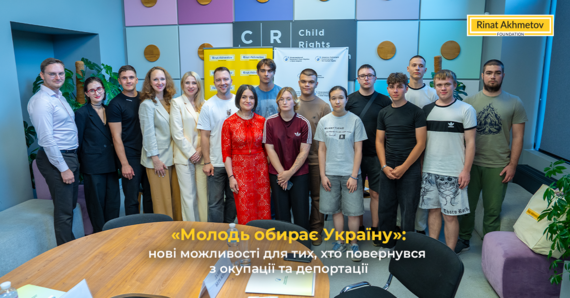
Participants of the pilot project “Youth Chooses Ukraine” gathered in Kyiv to learn about the next stages of the initiative, discuss their plans for the future, and explore the opportunities that open up to them after returning home. They are young men and women aged 18–23 who have returned to Ukraine after deportation, forced displacement, or prolonged exposure to an environment of total coercion in the temporarily occupied territories.
Among them is 18-year-old Danylo from the Zaporizhzhia region. After returning, he continued his education in Ukraine and dreams of finding a job to fulfill his potential.
“The event is very interesting. It is clear that the state is paying attention to youth development, because young people are the foundation of the future of our society. For me, it is important to find a good job so that I can fulfill my potential and help my family,” says Danylo.
It is for young people like him that the Rinat Akhmetov Foundation, in partnership with the Commissioner for Human Rights of the Verkhovna Rada of Ukraine and the Ministry of Youth and Sports of Ukraine, is implementing the “Youth Chooses Ukraine” project. It helps them adapt, determine their professional path, and build their future in Ukraine.
“For us, working with young people is an absolute priority. It is also one of the key priorities of our founder, Mr. Rinat Akhmetov. We are implementing this pilot project precisely on his initiative and by his personal decision,” said Natalia Yemchenko, Chair of the Supervisory Board of the Rinat Akhmetov Foundation.
Ksenia Sukhova, General Director of the Foundation, emphasized that the initiative is intended to lay the foundation for large-scale, systematic assistance at the state level:
“The goal of this project is to help the state create a national program through which young people will see and understand the opportunities available in Ukraine, return here, and have a clear understanding of the path and prospects that lie ahead of them. Our task is not only to help, but also to unlock their potential and give them the opportunity to fulfill themselves in Ukraine exactly as they dream of.”
The meeting also featured a panel discussion titled “People Who Create the Future of Ukraine.” The speakers emphasized: returning home is only the first step, after which a lengthy process of adaptation begins. After all, this is not a matter of one day, but a long and persistent process that requires support, new opportunities, and time for recovery and self-fulfillment.
“It takes 3, 6, 18 months of hard work for children to adapt to a new place, remember their roots, overcome all the hardships, and live through the traumatic experience they had in the temporarily occupied territory or in the russian federation,” emphasized Oksana Cherviakova, Representative of the Commissioner for Children’s Rights of the Verkhovna Rada of Ukraine.
Kyrylo Lapko, Deputy Head of the Coordination Center for the Development of Family-Based Care and Child Care, also emphasized the importance of pooling the resources and expertise of the state, the human rights institution, and the charitable organization. Such cooperation makes it possible to create a comprehensive support model that, after the completion of the pilot stage, is planned to be scaled up across the country starting in 2027.
“Our task is to ensure proper support and provide the necessary assistance to all children and young people who are returning. It is precisely such models, which are being developed today within this pilot project, that can become a strong foundation for future state and national decisions,” Kyrylo Lapko emphasized.
Twenty young people will take part in the pilot stage of the “Youth Chooses Ukraine” project. The programme provides six months of intensive work and one year of individual support. Participants will be assisted in obtaining education or a profession, finding employment, and successfully starting independent life. Comprehensive assistance includes several areas: psychological and medical support, career guidance and educational opportunities, assistance with employment, social adaptation, mentorship, legal support, as well as housing solutions for participants of the pilot project.