Rinat Akhmetov Foundation and the Office of the Ombudsman expand cooperation: parties sign memorandum
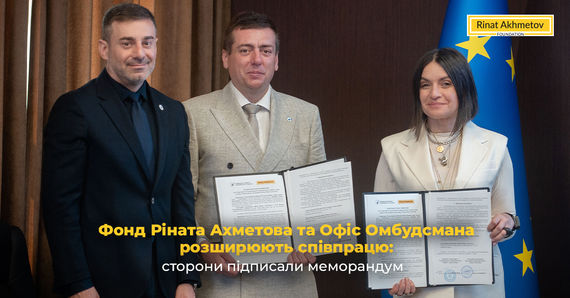
The Rinat Akhmetov Foundation and the Secretariat of the Ukrainian Parliament Commissioner for Human Rights (Office of the Ombudsman) have signed a memorandum of cooperation. The document marks a new stage of partnership focused on the development of the National Human Rights Protection Centre and the implementation of joint human rights and humanitarian initiatives.
Cooperation between the Foundation and the Office of the Ombudsman has been ongoing since 2023. Its first stage was implemented primarily through the Azovstal Heart project. At that time, the partners joined forces to support the defenders of Mariupol released from russian captivity and the families who continue to wait for their loved ones. Among other initiatives, the Foundation provided specialised transport to meet prisoners of war after exchange operations and contributed to other joint projects aimed at protecting their rights.
The new memorandum opens up significantly broader opportunities for cooperation. One of its key areas will be the development of the National Human Rights Protection Centre – a space that will bring together human rights projects, the documentation of war crimes, educational initiatives and the preservation of the memory of the war.
"Today, the Office of the Ombudsman is establishing the National Human Rights Protection Centre – a space that will help not only promote discussion about human rights but also work systematically to protect them. It is a great honour for us to be one of the four national partners of this project. At the same time, our task is not only to help create the Centre but also to fill it with meaningful content. That is why the Museum of Civilian Voices founded by the Rinat Akhmetov Foundation and the M86. Chronicle of the Defence of Mariupol exhibition will become an important part of this space as sources of testimony, memory and expertise about the war, human rights violations and the path towards restoring justice," said Nataliia Yemchenko, Chair of the Supervisory Board of the Rinat Akhmetov Foundation.
The Centre already houses two important exhibitions: Helmet of Memory. The Story Continues, dedicated to the 22 athletes who were killed in Mariupol, and M86. Chronicle of the Defence of Mariupol, devoted to the 86 days of the city's heroic defence.
"We want every international partner who comes to Ukraine not only to hear about the tragedy of Mariupol but to truly feel it. It is also extremely important for us to keep reminding the world about Ukrainian prisoners of war. The defenders of Mariupol remain one of the most difficult groups to bring home, and the more the international community speaks about them, the greater the pressure on russia will be," stressed the Ukrainian Parliament Commissioner for Human Rights, Dmytro Lubinets.
Another area of cooperation will focus on supporting young people aged 18 to 23 who return to Ukraine after deportation or after living in temporarily occupied territories as part of the presidential Bring Kids Back UA initiative. The parties will work on a project to help these young people adapt to life in Ukraine and gain opportunities for education, professional development and employment.
"For us, this cooperation is, above all, about people's future. Today, we are expanding our support programmes and, together with the Office of the Ombudsman, launching a new initiative for young people returning to Ukraine after deportation or life under occupation. It is important not only to help them come home but also to create conditions in which they can study, work, develop and build their lives here in Ukraine. This is about restoring the country's human potential," emphasised Kseniia Sukhova, Chief Executive Officer of the Rinat Akhmetov Foundation.
The partnership between the Rinat Akhmetov Foundation and the Office of the Ombudsman is thus entering a new stage, expanding from supporting prisoners of war and their families to comprehensive cooperation in the fields of human rights protection, preserving historical memory and supporting those who have suffered most as a result of the war.